"What do dwarves have to do with my dreams?"It is, I think, one of my better stories.
"Some dwarves forge dreams," I told her. "We make them out of moonlight and darkness, wind and cold, memory and emotion. It's alchemy and magic and forgecraft."
"And you think a dwarf made my dream?"
"If you've dreamed the same dream every night for a year, then it was dwarf-forged. No one else could make a dream that long-lasting."
"Why would they do that?"
"Someone paid him. Could be a rival, or an ex-lover, anyone." I knew a thing or two about ex-lovers and what they could do to one's dreams.
Madison shook her head. "I can't think of anyone. Who would even know how?"
The silence stretched between us, and I returned to adjusting my collector. Finally, Madison asked, "Is that what you do? Make bad dreams for whoever pays you?"
"No. I don't make dreams anymore." Not since the curse.
"Then what do you make?"
"Countermagic for bad dreams." I waited for her to accuse me of teasing her, or maybe trying to con her. That's what I would do in her position.
"Can you make something for me?"
I turned to face Madison. If she had any doubts, they didn't show. She was earnest, desperate. I felt like I was taking advantage of her, but business was business, and I was helping her.
Thursday, December 12, 2019
Dreamforger
Wednesday, November 20, 2019
Diet and Exercise
The doctor gave me the option of taking drugs, or trying to lose weight. I opted for the weight loss option, since I’m stubborn that way, and I have boundless—probably misplaced—confidence in my ability to discipline myself.
I've lost twenty pounds since then. Now there's probably nothing more boring than hearing someone talk about their diet and exercise program, but this is my blog, and I wanted a centralized place to point people to when they ask (and I have been asked).
The number one decision I made when I decided to do this was that I wasn’t going to diet and exercise, I was going to change my diet and exercise. This meant that this was permanent, so I wasn’t going to lose weight and stop, I was going to keep losing weight until I stabilized at a new weight, and then, if necessary, change my lifestyle further. It also meant that I was only going to do things that I felt I could live with for the long haul. This meant slower, but hopefully more sustainable, weight loss.
But I wasn’t going from a cold start, either. So let's start with before.
Before
Kristin is a wonderful cook, and I usually eat whatever food she provides. For dinner. For lunch, I'm on my own at work. Usually, I brought a cold cut sandwich and chips, though twice a week I would get food from one of the local restaurants instead—usually a steak bowl with rice, beans, guacamole, sour cream, pico de gallo, and lettuce from a local Mexican place, or a steak kebab with hummus, potatoes, and salad from a local Mediterranean place. I'd also have two, occasionally three, 12 ounce cans of Coke a day, sometimes with chips or pretzels for a snack.For exercise, I would do one of several seven minute workouts each day, using an Android app called 7, but the app has a lot of workouts aside from the original, and often I did a light version of the exercise. I also used dumbbells, doing a weight workout three times a week in theory, in reality more usually twice a week, performing eight exercises, each with two sets of ten reps, using light/medium/heavy weights of 5/8/10 pounds. Finally, I had a treadmill desk, which I used pretty much every day, walking at a slow pace of 1.5 mph for eight hours a week (1:20 six days a week), and a fast pace of 3 mph for two hours each week (on Saturday)—for a total of 18 miles each week over 10 hours.
I had also recently purchased an Oculus Quest virtual reality headset, and started using one of the high intensity games called Beat Saber as a more intense aerobic exercise.
So I wasn’t totally inactive, but there were ways to improve.
After
I had been getting pretty sick of sandwiches, so I was looking forward to changing things up. My doctor had suggested a Mediterranean diet, in particular replacing grains with legumes for carbs. This translated into a salad with meat (or as I like to think of it, steak on a bed of lettuce) and a side of beans or chickpeas. I reduced my Coke intake to one can a day, and my snack to a single serving of flavored, roasted chickpeas. For caffeine in the afternoon, I would have loose-leaf Chai tea, with milk and sugar (but not a Chai latte from Starbucks or similar, as that has as many calories as a Coke, while I'm aiming for less than half that). When I bought lunch, I would switch to the salad with meat theme for one meal a week. For dinner, Kristin moved to more legumes instead of grains and potatoes; but she didn't drop grains and potatoes, or even desserts, entirely.For exercise, I wanted to increase the intensity while increasing the time spent exercising as little as possible. So I did a number of things. First, I changed the exercises I was doing in 7 to a custom-built aerobic exercise four times a week (easier on my knees than the default aerobic one), and a custom-built long exercise program three times a week that combines a full-body workout with the stretching that I do before weight training. For weights, the first step was to consistently use them three times a week, and also to go from 2 sets of 10 reps to 3 sets of 8 reps. This was one of the biggest time increases. Then I bought some adjustable dumbbells to which I could add weight plates as needed, and I added two new exercises for which I needed more weight: farmer carries and leg lifts. I gradually increased the amount of weight for my exercises, from 5/8/10 to 10/15/20, while going from 8 to 10 reps, over the course of three months. I’ve recently switched to circuit training, doing sets of different exercises in a row without a rest in between, and then resting before repeating.
Next I changed up how I used my treadmill. Rather than doing all the faster walking on Saturday, I started doing half an hour at 3 mph and an hour at 1.5 mph six days a week, and an hour at 2 mph on Saturday (for a total of 20 miles over 10 hours).
Finally, I made Beat Saber a constant part of my exercise, combining twenty minutes of a more intense difficulty level with my aerobic exercise. I used the heart rate monitor on my smartwatch to make sure I was in the aerobic zone as much as possible.
When I plateaued after losing ten pounds, I made several additional small changes. I dropped the legume side dish and started sticking to the meat on a bed of lettuce lunch every weekday while reducing the meat from four ounces to three ounces. I also increased the speed of my fast-paced walk to 4 mph, turning it into a light jog, using my smartwatch to maintain the aerobic heart rate zone the entire time. Finally, I kept the additional hour on Saturday but reduced it from 2 mph pace to 1.5 mph, reaching a total of 22.5 miles over 10 hours.
![]() |
| My office--with treadmill desk, regular desk, and exercise mat. The desk chair has been moved to make space for VR. |
![]() |
| The other side of my office, with my weight bench. |
So, in summary:
3-4 times a week
- 7 minute aerobic exercise
- 20 minutes of Beat Saber
- 30 minutes jog at 4 mph
- 1 hour walk at 1.5 mph
3 times a week
- 30 minutes jog at 4 mph
- 15 minutes full body workout and stretching
- 1 hour of weight exercises
- 1 hour walk at 1.5 mph
Since I only jog six times a week, I can drop it once a week, or even skip all the exercise one day a week if I have another commitment, but I'll try to make up any walking so that I hit the same totals of 10 hours and 22.5 miles each week.
You'll notice that this consists of 2-2.75 hours each day, which seems like a lot. How do I get anything else done? One advantage of a treadmill desk is that I'm not just walking or jogging. I can watch television shows or read my Kindle app while jogging, and at a slower walk I can work on Mysterion or even write. While doing my weight exercises or even Beat Saber, I listen to podcasts or audio books. The only time I'm not doing something else is the 7-15 minutes I'm doing a prescribed exercise, where I need to listen to instructions from my phone. The biggest challenge is finishing the more intense parts before dinner. The walk, and even weights, can come later. Fortunately, we tend to eat dinner late—never before seven, and sometimes not until nine.
So far it's worked, but the temptation to cheat just a little is a constant danger, especially now that I've made real progress.
NaNoWriMo
I don't typically do NaNoWriMo, partly because November is a difficult month for me to set aside the time for it (though my wife and I have occasionally tried JaNoWriMo (there are actually a lot of versions of this)). But I decided now was a good time to increase my writing time. I've only been getting about 2.5 hours done each week since the July reading period for Mysterion started. Now that my work there is mostly done, I've bumped my writing per week up to 5 hours for November, making it a priority to write during my walking time. I used to frequently delay writing until I was done walking, surfing the web during the walk instead, but now I try to start writing as soon as I start walking. That has led to some procrastination from starting to walk, however.Wednesday, September 11, 2019
The Supervisor of Accountants and the Great Gray Wolf
This story is now out at Cast of Wonders Episode 372. Sometimes the unlikeliest people are called to be heroes. But what sort of heroism can one expect of a lowly administrator?
I was asked today where I got the idea from. As I always tell people, ideas are easy, it's the execution that's hard. I keep a list of ideas to write stories from. They come from all over. When I read a story or book or see a movie or television show, and wonder, "Why didn't the characters do this instead?" (This doesn't mean I rewrite the story with that change--it means I write a story where characters face a similar problem and try my solution.) When I have a philosophical, political, or religious idea, and I think it would be interesting to explore it in a story. When there's some technology that might have interesting implications. When I see something happen in real life or hear about it on the news and think that it may have story resonance. When I dream something. Sometimes just when I come up with a really good punchline. All of these get written down to be mulled over, to build into a robust system and then broken in the story that tells how they fail.
But sometimes I look over that list, and find that I'm just not ready to write any of those stories. It's too ambitious, or the idea's not fully formed, or maybe it wasn't such a great idea anyway. In that case, I start brainstorming. This is when worlds I've created and novels I've written but never published come in. I start thinking about other stories I can tell in those worlds, bits of backstory I can fill in for those characters, sequels and prequels to unpublished, sometimes even unwritten, stories.
And when that doesn't work, I try something crazy. In this case, I decided to come up with a wildly original title, and after that, the story would practically write itself. But it turns out that wildly original titles are hard to write too. I realized my best bet was to avoid cliché or common words, so I went to dictionary.com, and started working my way backwards through its words of the day, trying to figure out if any of the words, or better yet, combination of words, sparked something. I discarded puissant (actually sort of cliché in fantasy), selenotropism, metanoia, and complaisant. But two words stuck out at me, especially when I put them together: "doughty" and "panjandrum". And thus "The Doughty Panjandrum" became the working title of my story, and figuring out what such a person would be like gave me the story's voice.
So it turns out looking up random uncommon words and combining them into a title does work as a method to come up with a great story idea. Who knew?
Friday, August 16, 2019
More upcoming stories
The Lightning Generator
Back in 2017, I signed the contract to publish "The Lightning Generator" with a certain magazine. And then the fiction editor left and the magazine went on hiatus for a couple of years, and I pretty much assumed that the story would never see the light of day. The contract had a 3 year reversion of rights clause, though--that's the part of the contract that says if they haven't published it in that time, you're free to do what you want with the story--so I couldn't send the story anywhere else until that ended. Now the magazine's a print magazine, and a fairly long reversion of rights clause is standard for those. It takes a long time to go from story acquisition to print. But, man, when you're almost sure the magazine is dead, that's a long time for a story to languish. For the record, Mysterion's reversion of rights clause is 1 year, but we're a online magazine, so things move quicker in that world.
Anyway, I finally heard from the magazine this past week, and it turns out that not only are they not dead, they're publishing again, and they're definitely planning to publish my story. Not in the next issue, but in the issue after that. And as they haven't announced the story yet, I still won't name the magazine. Which may be for the best, considering what I said above. . .
But as to the story itself, here's my description:
When Professor Garson invents a device that can generate lightning and power a city, Morgan Dunworth's job security as an aether engineer looks a lot less certain. And when someone kills the professor for his invention, Morgan is unfortunately the primary suspect.
The Chamber of Winds
I first submitted this story to another magazine I'm not naming back in February of 2018. This is one of the few stories I submitted on invitation (more of a general invitation to people who'd gone to a specific writing workshop, not someone looking for a story just from me). In October, the editor said that they would publish the story. And finally, this week, I received the contract. I'll still hold off on announcing the magazine until it's made public, but here's a little about the story:
Raxtus makes a good living smuggling goods through the Hub, where his Domini masters have portals to all over the world. But it looks like he and his fellow workers will soon be replaced by automatons, and he needs to make sure he's settled all his debts before he's out on the streets.
So that's two stories about people concerned about losing their jobs due to a paradigm shift in technology. Hmm. Maybe that says something about my own fears, or maybe it's just coincidence that these two stories (which are connected, though I'll stay silent on how) happen to be reaching publication at around the same time. That's not all I write about, honest!
Thursday, August 08, 2019
Upcoming story: "The Supervisor of Accountants and the Great Gray Wolf" at Cast of Wonders
When the king tells the Supervisor of Accounts to the Second Under-Treasurer to jump, he jumps. And when the king tells said supervisor to hunt the Great Gray Wolf that all the knights and huntsmen seem to be avoiding, then he polishes his brass buttons, brushes off his good hat, and blackens his outdoor boots, all before setting out into the Old Wood.
I'm not sure which episode the story will appear in, but I'm looking forward to seeing it soon.
Sunday, May 05, 2019
Domus Lemurum
The story's behind a paywall, so only those with a subscription to Intergalactic Medicine Show can read the whole thing, but it will be out from behind it later this year. You can also read the story behind the story, wherein I wrestle with accurately portraying rather dismaying Roman attitudes, but that does contain spoilers for the story.
If you want to read more fiction by me, you can visit my writings page. If you want to read fiction that Kristin and I publish, visit the Mysterion website, and definitely visit our Patreon, where you can support our endeavors. We're desperately trying to reach $200/month, which will allow us to keep up with SFWA's increased pay rate.
Friday, October 19, 2018
Not-a-Review of Mythic Orbits 2
My story, "Her Majesty's Guardian," was a very short piece originally published by Daily Science Fiction. It asked the question of how a magic society would deal with a royal family with a genetic predisposition toward madness and a ridiculous amount of power.
Kristin's story, "The Workshop at the End of the World," is a more whimsical tale involving elves, and to say any more about the premise would be to spoil it. It was also published in Daily Science Fiction.
We're very proud of both these stories, of course, but like I said, I don't review books that I'm in, and I especially don't review my own stories, or Kristin's. But I would like to talk about some of the other stories in Mythic Orbits, and mention a few that really worked for me.
My favorite was "Mark the Days" by Kat Heckenbach. Denver begins to live his days by the order that he marks them off in his calendar. He takes advantage of this, skipping over days and coming back to them later, when he can take advantage of knowing what the following days bring. But slowly he comes to realize that there is something terrible waiting for him on the one day he skipped at the beginning, and eventually he won't be able to avoid it any longer. I felt that this story was successful in creating a rising sense of tension, and showing how someone might deal with knowing the future, while fearing to know the past.
Another story I really enjoyed was "They Stood Still," by William Bontrager. Anyone who uses a computer knows the frustration that happens when the computer freezes, and you're afraid to do anything, in case that makes you lose all your unsaved work. This story imagines what would happen if the whole world stopped. Samuel, who lost his legs in Iraq, suddenly has to deal with a Las Vegas empty of all motion except himself. I thought this story really dealt with his dawning horror, and the fear that he would never interact with anyone or anything ever again. I didn't feel like the story quite stuck the landing, however. I would have preferred a deeper meaning to this event than what we received.
Less grim was "Unerella" by Keturah Lamb. This tells the story of the other young woman at Prince Charming's ball, who has to figure out her own way when Cinderella steals his heart. There's nothing really twisty about this story, once you figure out that it's not from Cinderella's point of view, but I enjoyed the determination of a young woman who had to learn to dream something new.
"The Other Edge" by C.W. Briar was a particularly memorable dark science fiction tale. Astronaut Varik Babel leads his crew to make first contact with a ship from another world. What he finds is not what he's looking for. I did find the ending somewhat implausible, given what I know of the technologies involved, but it was horrifying even so.
"Dragon Moon" by Linda Burklin was a bittersweet story about Darla, a young woman who slowly covers herself in tattooed scales to entertain and distract her younger brother, who's dying of cancer. While I can't imagine someone doing that--I kept thinking that she must be crazy to do so--it brought out the depth of her love for her brother. The fantastical ending to this story was dramatic and appropriate, but I felt that the denouement too easily canceled the price that Darla had paid.
These were the stories that really drew me in and which I found myself thinking about days after reading. But our experience of stories is subjective, and I suspect other readers might find themselves reliving some of the other stories in this anthology, such as that of the mother bear searching for her lost cubs, or a curator explaining Earth culture to his alien overlords, or a failed Mars colony recalled to Earth, or robots replaying forgotten memories. I think most people will find something to enjoy in this anthology. Perhaps even a story about a queen's guardian, or a workshop at the end of the world.
Sunday, October 07, 2018
Mythic Orbits

This is a guest post, posted as part of the Mythic Orbits blog tour. Kristin and I are both in Volume 2 of Mythic Orbits.
About Mythic Orbits

Mythic Orbits 2016
Featuring Graxin by Kerry Nietz, author of Amish Vampires in Space and A Star Curiously Singing, Mythic Orbits 2016 has something for every speculative fiction fan.
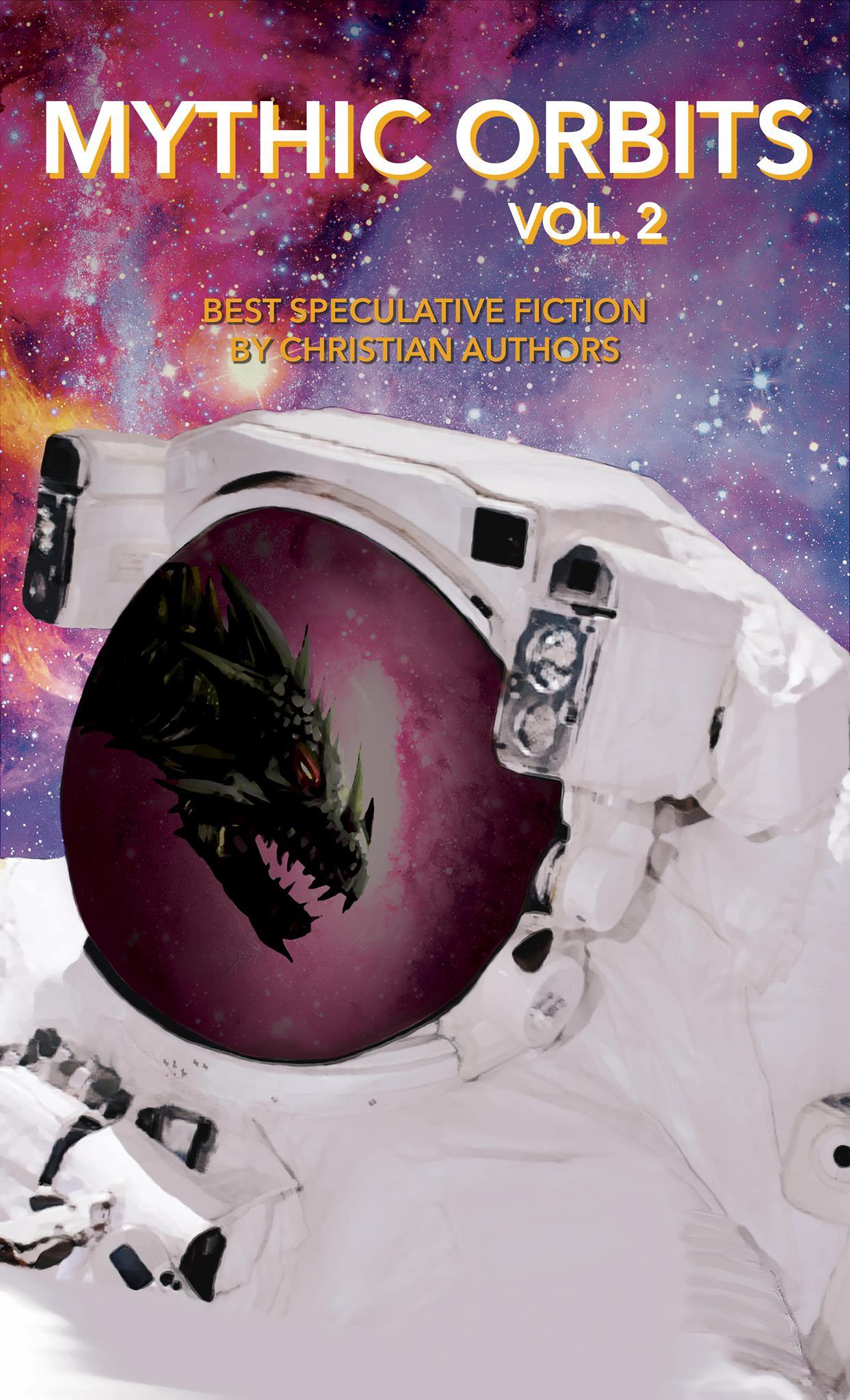
Mythic Orbits Vol. 2
Featured Authors:
- Mark Venturini (Mythic Orbits 2016)
- Jill Domschot (Mythic Orbits 2016)
- Richard New ( Mythic Orbits 2016)
- Kirk Outerbridge (Mythic Orbits 2016)
- Cindy Emmet Smith (Mythic Orbits 2016)
- Lisa Gefrides (Mythic Orbits 2016)
- L. Jagi Lamplighter Wright (Mythic Orbits 2016)
- Joshua M. Young (Mythic Orbits 2016)
- Matthew Sketchley (Mythic Orbits 2016)
- R. V. Saunders ( Mythic Orbits 2016)
- Sherry Rossman (Mythic Orbits 2016)
- Kerry Nietz (Mythic Orbits 2016)
- Linda Burklin (Mythic Orbits 2016 & Vol. 2)
- Kat Heckenbach (Mythic Orbits 2016 &Vol. 2)
- Steve Rzasa (Mythic Orbits 2)
- Donald Crankshaw (Mythic Orbits 2)
- CW Briar (Mythic Orbits 2)
- Cindy Koepp (Mythic Orbits 2)
- C. O. Bonham (Mythic Orbits 2)
- Kristin Janz (Mythic Orbits 2)
- William Bontrager (Mythic Orbits 2)
- A. K. Meek (Mythic Orbits 2)
- Keturah Lamb (Mythic Orbits 2)
Sunday, June 11, 2017
Untranslatable Words
He pointed me to an article he worked with his colleague Adrian to write, with 35 other foreign words. As the article states:
Have you ever found yourself struggling to find the perfect word? You have an experience that feels so…so…but no words exist. You want to insult someone but can’t find a word vicious enough. You want to speak words of tender affection to your partner but no such words exist in the English language.
Thankfully, there are other languages we can turn to in our time of need. Here are 25 [actually 35] amazing foreign words that don’t exist in English. Use these words when English fails you.Thanks, John.
Saturday, September 10, 2016
I want one
I've been thinking recently about getting a new tablet. Currently, the only tablet I have is a 7" Amazon Fire. Which is great for consuming content, but I was thinking it was time for something with a little more meat. I don't intend for this to be a primary productivity device for me. I have a laptop for that, which I'm quite fond of. So the tablet would still be a media consumption device. But I would like it to be at least a little bit more capable of productivity. I now have an official work laptop (a Mac Powerbook that I'm not crazy about--but that's because I have a bias against Macs), and I don't feel like I can take two laptops to the office. But I often miss having my personal laptop when I have to stay late or I'm traveling and want to do personal stuff, such as writing. You can get keyboards with plenty of tablet devices, so that seems like it could be the way to go. I also would like something I could get LTE access with, so I'm not always tethered to WiFi.
I was thinking of getting the Samsung Galaxy Tab S2, but my cellular provider just stopped offering it, and I'm not sure I can get the cellular version anywhere else. And then I saw this:
That is the Lenovo Yoga Book. It's internals are nothing to write home about: Atom x5 processor, 4 GB RAM, 64 GB storage. The screen is 1920x1200 LCD (I really want an OLED screen, but that's not available). Fortunately, it does allow you to add microSD storage up to 128 GB, and it apparently does have LTE. What's really interesting is that it has a keyboard--sort of. Its Halo keyboard is actually a touchpad with haptic feedback. I'm not sure how easy it would be for me to type on, so I wouldn't want to use this for my primary productivity device, but it could be good enough for those times when I want to spend a little time writing.
What's most interesting is that the touch keyboard transforms into a writing surface, like a Wacom tablet, that records what you write or draw. I'm not much of an artist myself, but I do like paper notes.
It also comes with the option of either Android or Windows 10. I like Windows 10, or at least prefer it over Windows 8, but Android is better for media consumption, in my opinion. At the very least, Amazon allows you to download videos onto Android, not Windows. For productivity, the one thing I'd really miss with Android is that Scrivener is not available for it--yet. Scrivener is my primary writing tool, and I'd really like to be able to use it when I'm on the go. But the iOS version of Scrivener just released, and I know they've been working on the Android version, so I'm hoping that the Android version will be available some time in the next year.
So I'm definitely considering this device. I'll probably wait for reviews before shelling out $499 for it, though.
Thursday, September 01, 2016
Mysterion is here
We hope you enjoy it as much as we did. And once you read it, consider writing a review.
Here's how we describe our anthology:
The Christian faith is filled with mystery, from the Trinity and the Incarnation to the smaller mysteries found in some of the strange and unexplained passages of the Bible: Behemoth and Leviathan, nephilim and seraphim, heroes and giants and more. There is no reason for fiction engaging with Christianity to be more tidy and theologically precise than the faith itself.
Here you will find challenging fantasy, science fiction, and horror stories that wrestle with tough questions and refuse to provide easy answers or censored depictions of a broken world, characters whose deeds are as obscene as their words and people who meet bad ends—sometimes deserved and sometimes not. But there are also hope, grace, and redemption, though even they can burn like fire.
Join us as we rediscover the mysteries of the Christian faith.
"A fascinating look at Christianity through the prism of speculative fiction."
—Nebula Award-winning author Eric James Stone
"The stories in Mysterion ranged from the dusty preachings of a devout Roomba to a meditation on empty houses in heaven. I thoroughly enjoyed them all. General readers will appreciate the anthology for its diverse, entertaining tales, while those who enjoy provocative questions of faith and morality will find the collection especially rewarding."
—Livia Blackburne, New York Times Bestselling Author of Midnight Thief
Wednesday, March 16, 2016
(Another) new story out: Marked Man
But in the meanwhile, I have a story out in Andromeda Spaceways Inflight Magazine #62. "Marked Man" is a weird western about what happens when the past catches up with you. The story comes with a cool piece of art in the magazine.
A quick taste:
Heath knew the look of a man who meant to shoot another. There was no mistaking it in Eustace’s eye, so he drew his own weapon. No man could draw a gun faster than another could pull a trigger, though, even with the sort of help Heath had. The loud report of gunfire echoed off the buildings lining the street.
Another followed a second later, and Eustace went down. Itching burned across Heath’s chest, but he ignored both it and the wave of exhaustion that washed through him. He holstered his gun as he patted Murdoch. It was a good horse who didn’t shy during gunplay—or a deaf one. He hadn’t owned Murdoch long enough to be certain which he was.
As Heath dismounted, a flat disc of lead tumbled out of the folds of his shirt. He stooped to retrieve it from the dirt and deposited it in his pocket, forcing himself upright despite his trembling legs. It wouldn’t do for someone to find the disc and figure out what had happened. He checked again that his sleeves were all the way down and his shirt buttoned all the way up, just to be sure. He thought the Mark of Warding could take another shot or two, but it was best not to give anyone else a reason to shoot him.You'll have to buy the magazine to read the rest (no free version this time around).
Wednesday, November 11, 2015
New story out: Dynasty of the Elect
Tchel didn't turn around, his fore eyes remaining focused on the computer screen. His rear eyes could see his counterpart's bulk filling the office door just fine. Heldiss was large even for a 17th leveler, his arms as big as Tchel's forelegs, his forelegs thicker than Tchel's hind legs. Unlike Tchel, he wore the 17th level body with a heavy grace, maneuvering the low slung form easily. Even after a full term in this form, Tchel found it too big and ungainly, a throwback to early industrialization when the chief engineer needed a strong body to handle the massive machines more than he needed a strong mind. Heldiss would have fit in better then.Enjoy!
Sunday, October 25, 2015
Stew!
Obviously, no one’s going to be cooking up a pot of stew over their campfire after marching 20 miles. But in an inn or tavern, where the proprietor and staff have been there all day? Perfectly reasonable. Far more reasonable than steak, in fact. For one thing, most of the meat on a cow (or any other quadruped) isn’t tender enough to be turned into steak. It requires long, slow cooking in some kind of liquid (also known as “stewing”). Even more so before the advent of modern factory farming and feedlot practices. And, before the invention of refrigeration, most of the meat people ate would have been salted, dried, and/or smoked. Salted meat especially needs to be soaked and boiled before it’s palatable again–an excellent candidate for stew. It doesn’t make sense to kill a large animal for fresh meat unless there are enough people around to eat it before it spoils. So you might do this for a wedding or other special occasion, but the suggestion that a typical inn serving ordinary travelers should specialize in steak instead of stew is a bit ridiculous.
Saturday, August 15, 2015
Mysterion
We’re not necessarily looking for unambiguously pro-Christian stories: we want to be challenged as much as encouraged. Thematically, we're looking more for Flannery O'Connor than C.S. Lewis. You can read more about it at www.mysterionanthology.com, especially in our Submission Guidelines and Theme Guidelines.
We open for submissions on October 15th.
Saturday, August 08, 2015
Realm Makers
Some of those ways were disappointing--there were a lot fewer parties, and those parties were much more structured, with a lot of announcements and prizes, but less time for socializing that I'd expect at a party. Also, pretty much every event, from the awards, lunch and dinner (which were mostly provided), and the parties, were sponsored by one publisher or editor or another, which meant that each event would contain a lengthy spot for that sponsor to advertise themselves, usually by talking about what they do. Now, some of this should be expected, but I would have preferred if the promotional spots were more in line with two minutes rather than ten.
But on the other hand, its classes were much more focused, led by a single expert rather than a panel, and generally more instructive. I mostly attended a continuing session led by David Farland, a famous writer who has mentored a lot of other even more famous writers, such as Brandon Sanderson and Stephenie Meyer.
This was probably the most productive conference I've ever been to. Now, I've been to large conferences like World Fantasy and Worldcon, as well as local ones like Boskone and Readercon. And I've met a lot of great people at them. But perhaps because this was a small conference, 150 as opposed to thousands, I've never had a chance to meet so many successful authors and publishers, or to pitch to two agents, or attend a masterclass on writing run by David Farland. I think I learned more, made more connections, and made more progress in my own writing than any other con I've attended. So it was definitely a worthwhile experience.
Of course, the main reason Kristin and I went to this conference was so we could recruit people for a project we're working on. I'll be announcing that on this blog in the next few days.
Thursday, February 20, 2014
Short stories
So what does that mean? Despite my modest success selling short stories, I'm probably never going to be a really successful short story author if I don't actually like short stories. And, in fact, the stories I've had the most success selling are either short, funny stories--more like blog posts or Cracked.com articles than short stories, in fact--or really long stories, novelettes or novellas or even serial short novels. And I think perhaps I should focus on my strengths. I'm not going to say that I'll never write and try to sell a short story again--when story ideas come, I need to write the form that fits them. But most of my ideas, and most of what I want to write, are novels. It's the fiction I love to read, and it's the fiction I should be writing.
Wednesday, October 09, 2013
New card
![]() |
| New business card. |
The reason for the new card is that I also had a new role to advertise, that of a book reviewer at Black Gate. Since I'm reviewing self-published books, I thought it might be good if my card had that information to hand out.
Monday, October 07, 2013
Co-writing
On and off, my wife and I have talked about co-writing a story. We're both published writers, but we have noticeably different strengths and weaknesses. It seems like a co-written story might be able to combine our strengths and cover our weaknesses. And hopefully not the other way around. One problem I'm running into is figuring out how. How do two authors write a story together? I have a few ideas, but nothing's really seemed like it's the right way. Then again, there may not be a right way.
Here are the ideas:
1. Alternating revisions. What if just one person wrote the first draft, and the next person revised it? "How's that different than editing?" you ask. Complete creative freedom. The reviser isn't limited to line edits. They can make whatever changes they see fit. Deleting scenes, writing new ones, changing the entire course of the story. Of course, at that point, the story is returned to the first author, and he's free to make whatever changes he wants. At some point the two authors are going to have to negotiate, but at least at the beginning they're free to do whatever they want.
2. Alternating writing. A lot of writing groups have done the exercise where the first person writes a paragraph, then hands it to the next person, who reads the first paragraph and then writes the next one. If you've done it, you've probably seen how quickly the exercise goes off the rails. Someone will write something the next person finds absurd, and soon everything up to that point becomes a dream or a daydream. So first, you probably shouldn't do it by paragraph. It would work better if you do it by scene. You also have to set some ground rules. Like what type of story it should be, no retconning without permission, that sort of thing. In theory it could work.
3. Joint Outlining. I have a feeling that this is the most common way of co-writing. Two people sit down and come up with a story: the characters, the plot, the setting, etc. And then once it's planned out, they split up the work between them. This is probably the most effective way to do it.
4. Backseat writing. You literally write it together. One person looks over the other's shoulder as they type into the computer. I've done that, usually for work, and it's really slow and not much fun. It generally means debating word choice for every little thing. I can imagine that many projects will require some of this, but I can't imagine writing a whole story this way.
Any other ideas?
Monday, September 02, 2013
The gesture keyboard
This is more of a comment on Android than on my phone in particular, but I'm starting to get the hang of the gesture keyboard that Android uses. It's much faster than the hunt-and-peck method I'm used to. Still, I've seen people much more practiced than I use it, so I know I have a ways to go. That said, I am getting better at it. And it's surprisingly forgiving if you make a mistake, and need to change your direction in the middle of a stroke. Or even if you're not quite on target with your strokes. Give me a little more practice, and maybe I'll try writing a novel with it. I've already used it for a couple of flash fiction stories.
It's also gotten me to start holding the phone in portrait mode when I type. With my iPhone, I always used my phone held in landscape whenever I needed to type something, so that I could use both thumbs without needing to reach across the keyboard. With the gesture keyboard, it's actually easier to hold in portrait, since that makes the keyboard, and thus my gestures, smaller. My new phone also has a bigger screen than my iPhone, so the keys are big enough when held in portrait, and the gesture keyboard is forgiving enough, that I don't need to make the keyboard larger by holding it in landscape. I haven't quite gotten the hang of doing the gestures one-handed with just my thumb, though. I can type that way, though it's more of a stretch with the larger screen, but it's hard to do the gestures.
Now all I need is Scrivener for Android, and I'll be set.